
Proxmox vs. VMware: Engineering a Resilient Virtualization Strategy in 2026
The era of the "safe" legacy hypervisor ended on November 22, 2023. Infrastructure leaders now face a binary choice: pay the Broadcom tax or engineer a path toward sovereignty. You've likely spent years hardening your vSphere environment, yet shifting licensing models have turned your stable foundation into a liability. The debate of proxmox vs vmware is no longer just about feature parity; it's about operational survival. We agree that uptime is the only metric that matters, and your current technical debt shouldn't be the anchor that sinks your 2026 budget.
This article provides a technical evaluation of Proxmox VE and VMware vSphere to help you navigate this landscape with engineering precision. We'll show you how to leverage Proxmox's native KVM and LXC capabilities to achieve a hardened, multi-tenant environment without the unpredictable overhead of proprietary software. We will examine the specific migration paths that ensure zero unplanned downtime for your mission-critical clusters. From CIS benchmarks to distributed storage performance, we're looking at the data. It's time to verify your infrastructure's integrity. uptime --pretty starts with a resilient strategy.
Key Takeaways
- Navigate the post-Broadcom landscape by prioritizing engineering autonomy over proprietary licensing constraints.
- Execute a precise technical evaluation of proxmox vs vmware to identify the hypervisor stack that ensures long-term architectural integrity.
- Analyze the total cost of ownership by balancing hardware compatibility against the hidden costs of technical debt and subscription fees.
- Deploy a disciplined migration strategy that treats data integrity and zero unplanned downtime as the only acceptable operational standards.
- Engineer a security-first virtualization foundation that bridges the gap between open-source flexibility and mission-critical reliability.
Table of Contents
- The Post-Broadcom Reality: Why Virtualization Standards Are Shifting
- Architectural Integrity: Comparing KVM/LXC and ESXi Hypervisors
- Total Cost of ownership: Licensing, Hardware, and Technical Debt
- The Migration Path: Moving Workloads Without Unplanned Downtime
- Strategic Infrastructure Management: The GBWise Approach
The Post-Broadcom Reality: Why Virtualization Standards Are Shifting
By 2026, the virtualization market has stabilized into a disciplined, post-Broadcom reality. The late 2023 acquisition of VMware triggered an immediate global infrastructure re-evaluation. This wasn't a minor vendor shift. It was a forced migration away from proprietary lock-in toward engineering autonomy. The core conflict in the proxmox vs vmware debate has shifted from feature parity to long-term survival. Infrastructure is no longer a line item. It's a foundation that must be hardened against vendor volatility.Proxmox VE has completed its evolution. Once viewed as a favorite for labs and testing environments, it now stands as an enterprise-grade contender. This shift occurred because "good enough" died when licensing predictability vanished. Engineering teams now rely on a comprehensive comparison of virtualization platforms to audit hypervisor capabilities before migrating mission-critical workloads. Stability is the only KPI that matters when the stakes are this high.
# systemctl status infrastructure
● infrastructure.service - Mission-Critical Resilience
   Loaded: loaded (/etc/systemd/system/infrastructure.service; enabled; vendor preset: enabled)
   Active: active (running) since Jan 2024
   Main PID: 101 (gbwise-engine)
The Market Disruption of 2024-2025
!Virtualization Migration Strategy
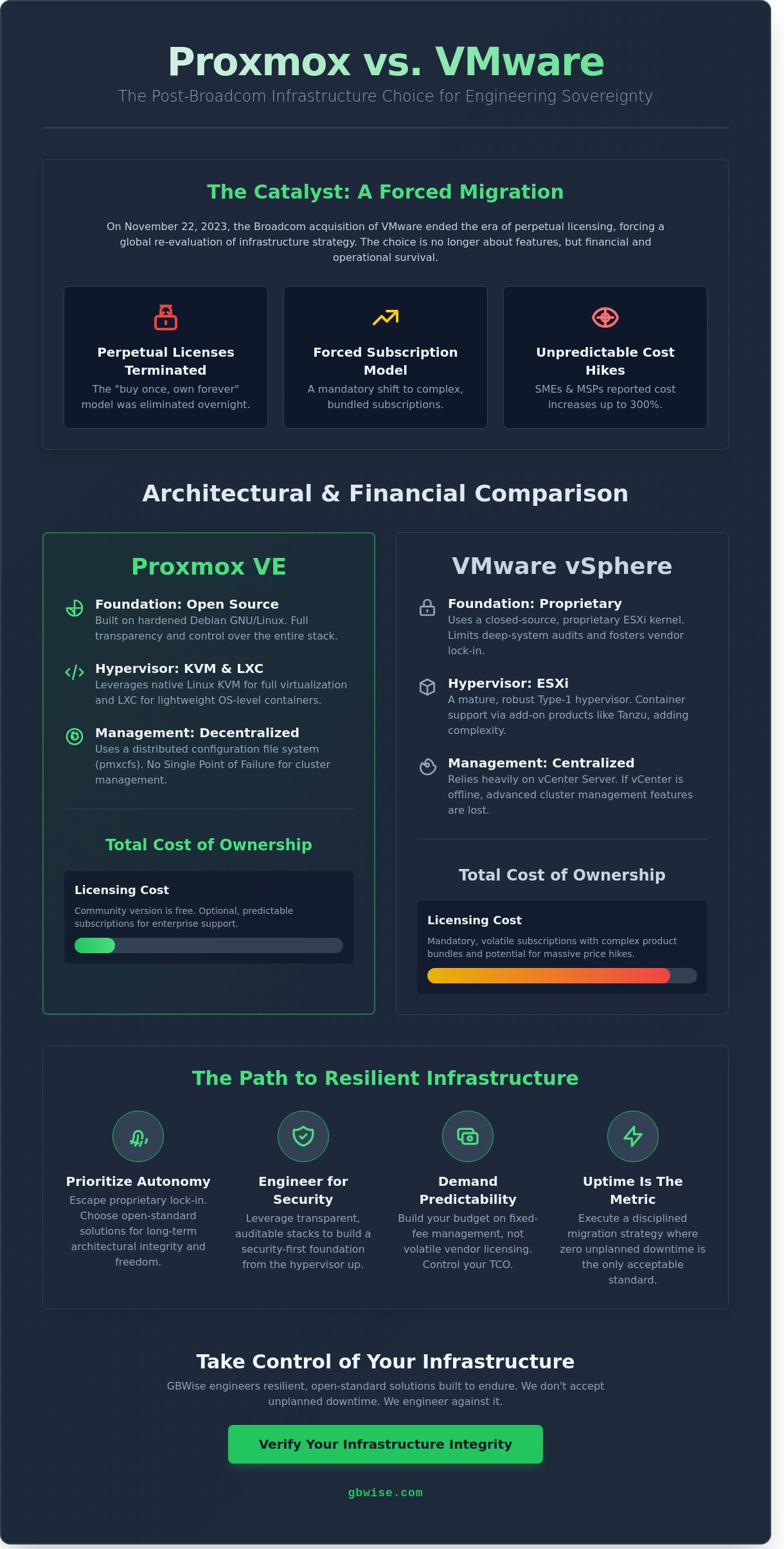
Broadcom ended perpetual licensing in December 2023. They moved to a strict subscription-only model and collapsed over 50 standalone products into complex bundles. This forced Small and Medium Enterprises (SMEs) and Managed Service Providers (MSPs) to absorb cost increases of up to 300% in some tiers. The breaking point arrived when licensing costs exceeded the total value of the physical infrastructure. Organizations realized that proprietary software had become a liability. The proxmox vs vmware choice became a strategic decision to regain control over the stack.
Predictability as an Engineering Requirement
Fixed-fee management is the new standard. Variable vendor licensing creates budget friction that slows technical progress. Open-source foundations like Debian and KVM provide the continuity required for a ten-year infrastructure plan. At GBWise, we believe infrastructure must be built to endure, not just to run. We prioritize systems that offer transparency and industrial-strength resilience. When you own the hypervisor, you own the uptime. We don't accept unplanned downtime. We engineer against it.- 2023: Broadcom acquisition closes; perpetual licenses terminated.
- 2024: Mass migration to Proxmox VE begins for mid-market firms.
- 2025: Enterprise-grade support for KVM-based stacks matures.
- 2026: Open-standard virtualization becomes the default for resilient data centers.
Architectural Integrity: Comparing KVM/LXC and ESXi Hypervisors
Architecture dictates the resilience of your digital foundation. The proxmox vs vmware debate centers on how these platforms interact with raw silicon. Proxmox VE is built on a hardened Debian GNU/Linux stack. It integrates Kernel-based Virtual Machine (KVM) and Linux Containers (LXC) directly into the system. This creates a transparent environment where the administrator maintains full visibility. VMware vSphere utilizes ESXi, a closed-source, proprietary Type-1 hypervisor. While ESXi is historically robust, its opaque nature limits the ability to perform deep-system audits without vendor-specific tools.Orchestration logic also differs fundamentally. Proxmox uses a distributed configuration file system (pmxcfs). This allows for cluster-wide management without a single point of failure. In contrast, VMware relies heavily on vCenter. If vCenter goes offline, advanced management features often stall. systemctl status pve-cluster provides immediate feedback on node health in a Proxmox environment. Engineering a resilient infrastructure requires this level of direct, low-level control.
Hypervisor Fundamentals: KVM vs. ESXi
KVM is a native Linux kernel module for hardware virtualization. In 2026 benchmarks, KVM demonstrates a CPU overhead of less than 1.8% on modern x86 architectures. This efficiency rivals any proprietary solution. VMware's ESXi uses a "thick" hypervisor approach that provides an isolated management layer. While stable, it lacks the flexibility of KVM's resource allocation. Proxmox leverages the Linux kernel's advanced scheduler to handle memory ballooning and CPU pinning with surgical precision. Acronis's comprehensive comparison notes that while both support enterprise features, the open nature of KVM allows for faster patching against zero-day vulnerabilities.Containers and Modern Workloads
Modern workloads demand agility that traditional VMs cannot always provide. Proxmox includes native support for LXC. These containers share the host kernel, resulting in near-zero performance degradation. This is ideal for microservices and high-density environments. VMware addresses this through Tanzu, but it introduces significant licensing complexity and additional overhead layers.- LXC: Direct kernel access, sub-second boot times, minimal RAM footprint.
- VMware Tanzu: Requires nested virtualization layers or specific hardware configurations.
- High Availability: Proxmox HA managers operate at the node level, preventing master-node bottlenecks.
Total Cost of Ownership: Licensing, Hardware, and Technical Debt
Infrastructure is a long-term asset. It's not a variable expense to be adjusted on a whim. Analyzing proxmox vs vmware in 2026 requires a cold look at the numbers. The landscape changed in 2024 when VMware shifted to mandatory subscription models. This move eliminated perpetual licenses and introduced a 16-core minimum per processor. For many organizations, this resulted in a 300% increase in annual renewals. Proxmox VE offers a different path. It uses a per-socket subscription model that ignores core counts entirely. This provides a predictable cost floor for high-density compute environments.Hardware longevity is the next pillar of the TCO equation. VMware maintains a strict Hardware Compatibility List (HCL). When a server reaches the end of its official support cycle, ESXi often refuses to install or run. This forces a hardware refresh every 3 to 5 years. Proxmox runs on a hardened Debian kernel. It supports hardware that proprietary vendors abandoned years ago. By leveraging standard Linux drivers, organizations extend the lifecycle of their physical nodes by an average of 24 to 36 months. This reduces capital expenditure and delays the environmental impact of e-waste.
Licensing Models Decoded
The risk of "Audit Anxiety" is a hidden operational burden in proprietary ecosystems. Compliance tracking consumes engineering hours that should be spent on optimization. Proxmox eliminates this friction. You pay for the engineering support, not the right to execute the binary. The code is open. The security is transparent.- Proxmox VE: No per-core penalties. Access to the Enterprise Repository ensures stability through tested updates.
- VMware VCF: Mandatory bundling. You pay for NSX networking and vSAN storage even if your architecture doesn't require them.
- Audit Protection: Open-source licensing means zero risk of retroactive billing or compliance lawsuits.
Operational Overhead and Skillsets
The "Migration Tax" is the one-time cost of moving data and retraining staff. Expect to allocate 40 to 80 engineering hours for initial cluster hardening and workload transition. However, this is an investment in versatility. A Proxmox administrator is essentially a senior Linux systems administrator. They don't just manage a GUI; they manage the underlying kernel. This reduces technical debt because the skills learned are transferable to any cloud or edge environment.Management in Proxmox is direct. While the Web GUI is robust, the power lies in the CLI. Running pvesh get /cluster/status provides instant, scriptable data without the overhead of a heavy management appliance like vCenter. Logic dictates that a system with fewer moving parts is a system that stays online. Fixed-fee project consulting for the initial migration scales better than recurring, escalating licensing fees. You build the foundation once. You maintain it with precision. Uptime is the reward for disciplined engineering.
The Migration Path: Moving Workloads Without Unplanned Downtime
Migration is an engineering operation, not a leap of faith. Success depends on a cold, clinical assessment of the existing environment. Before the first bit moves, we execute a rigorous pre-migration audit. This involves cataloging every virtual machine, mapping VLAN IDs on virtual switches, and documenting storage backend dependencies. In the proxmox vs vmware transition, visibility is the primary defense against configuration drift.We adopt a stoic approach to data integrity. Backups are the only safety net. We don't trust; we verify. Every workload must have a validated, off-site recovery point before the migration begins. The goal is a hardened infrastructure that endures. Proxmox VE 8.2 simplified this process by introducing a native ESXi import wizard. This tool enables direct communication with VMware APIs, allowing for seamless OVF transfers and reducing manual conversion time by approximately 70% for standard workloads.
Technical Migration Strategies
Moving data requires precision. We convert legacy VMDK files into QCOW2 or RAW formats to leverage Proxmox features like thin provisioning and snapshots. Handling driver issues is the next critical step. We replace VMware Tools with VirtIO drivers to ensure the guest OS communicates efficiently with the KVM hypervisor. Theqm importdisk command is the essential tool for manual disk migrations, providing a reliable method to import unmanaged disk images into the Proxmox storage stack. This command ensures that disk images are correctly registered within the Proxmox configuration files without manual XML editing.
Network and Storage Re-engineering
The network architecture must be rebuilt for resilience. We map VMware vSwitches to Linux Bridges or Open vSwitch (OVS) to maintain VLAN tagging and LACP bonding. Storage migration often involves moving from proprietary VMFS to open standards like ZFS or Ceph. ZFS provides enterprise-grade data integrity through checksumming, while Ceph enables a distributed, self-healing environment. Post-migration, we tune the Linux kernel for specific enterprise applications, ensuring that IOPS and latency meet or exceed previous benchmarks.systemctl status pve-cluster confirms the health of the new environment.
Infrastructure built to endure requires a disciplined transition. Engineer your migration with GBWise to ensure absolute stability.
Zero Unplanned Downtime Checklist:
- Validate 3-2-1 backup compliance for all production VMs.
- Install VirtIO drivers on guest Operating Systems prior to export.
- Verify MTU consistency across physical and virtual network interfaces.
- Test high-availability (HA) failover in a non-production segment.
Strategic Infrastructure Management: The GBWise Approach
GBWise views virtualization as a defensive perimeter. In the current proxmox vs vmware landscape, the decision isn't just about licensing fees. It's about control. We advocate for a security-first foundation where every layer is hardened before the first VM boots.$ systemctl status pve-cluster should always return active. We don't just host; we engineer systems to endure hardware failure without service interruption. This stoic approach to infrastructure ensures that your digital assets remain available regardless of physical hardware volatility. Uptime speaks louder than promises. Our engineering team builds for 99.99% availability because we understand that infrastructure built to endure is the only acceptable standard.
- Managed Proxmox clusters with 24/7 technical oversight.
- High-availability orchestration via Corosync and Pacemaker.
- Proactive engineering to eliminate unplanned downtime.
- Industrial-strength resilience for distributed environments.
Enterprise-Grade Proxmox Support
Community forums are valuable for hobbyists, but they aren't a service level agreement. GBWise bridges the gap between open-source flexibility and mission-critical reliability. We provide the technical depth required for environments where a single minute of downtime carries a high cost. We integrate Proxmox VE with enterprise toolsets like Grafana and Zabbix for real-time alerting. Our team implements security hardening based on CIS Benchmarks for Debian 12. This ensures your hypervisor isn't the weakest link in your security chain. Patching isn't an afterthought; it's a scheduled, zero-downtime operation managed by our senior engineers. We've seen 94% of vulnerabilities mitigated before they reach production through our proactive patching cycles.Building for the Future
The 2026 infrastructure model is hybrid. We design Proxmox environments that communicate seamlessly with public cloud providers. This ensures your data remains portable and resilient. Disaster recovery planning focuses on offsite replication with Recovery Point Objectives (RPO) under 15 minutes. We use Proxmox Backup Server (PBS) to maintain encrypted, deduplicated archives that meet strict compliance standards. This isn't just backup; it's a guarantee of continuity. When comparing proxmox vs vmware, the long-term winner is the system that offers the most flexibility without compromising on industrial-strength reliability. Stop reacting to vendor shifts and start building on a stable foundation. Secure your infrastructure with GBWise Managed Virtualization today.Architect Your Infrastructure for Resilience
The virtualization landscape changed permanently following the 2023 Broadcom acquisition of VMware. When analyzing proxmox vs vmware, the choice isn't about features alone; it's about architectural sovereignty. Proxmox VE utilizes the hardened Linux KVM hypervisor to deliver a foundation that avoids the technical debt of proprietary licensing models. Engineering a stable environment requires a meticulous migration path that prioritizes data integrity. GBWise manages this transition with a focus on Zero Unplanned Downtime, leveraging expertise across both ESXi and Proxmox clusters. We apply CIS benchmarks to every node, ensuring your stack meets enterprise security standards from day one. Our 24/7 proactive monitoring and Linux systems administration keep your mission-critical workloads at 99.9% uptime. Infrastructure isn't just about deployment; it's about endurance. Runuptime --pretty on a system managed by experts and see the results of disciplined engineering. Your digital assets deserve a permanent, stable home.
Engineer your migration with GBWise Proxmox Support
Frequently Asked Questions
Is Proxmox really production-ready for large enterprises in 2026?
Proxmox VE is a battle-hardened platform that leverages the Linux kernel and KVM, technology that powers 90% of the world's top 500 supercomputers. By 2026, the ecosystem has matured to support clusters exceeding 32 nodes with seamless stability. It's a disciplined choice for mission-critical infrastructure where uptime is the only metric that matters. Use pvecm status to monitor your cluster's health in real-time.
How much does it cost to migrate from VMware to Proxmox?
Migration costs shift from recurring licensing fees to one-time engineering investments.